
See drones live.
Each drone on the map with its altitude and speed. Plus the pilot's location.
- Altitude
- 85 m
- Speed
- 6 km/h
- Distance to pilot
- 405 m


HARQ · For businesses, industrial sites and critical infrastructure


Drones with Remote ID broadcast a signal, and HARQ sensors pick it up. Your security team sees each flight on a map, gets an alert within seconds, and every flight near your site goes into the archive. You pay one monthly fee per site. Hardware, installation and service are included.
from €190 / month + VAT · hardware included · no connection to your network
HARQ only receives. It doesn't transmit anything or jam drones.
Cameras, fences and gates guard your site up to the roofline. None of them will notice a drone over the yard.
Each drone on the map with its altitude and speed. Plus the pilot's location.
Alerts arrive on your phone and in the console. On the Facility and Critical infrastructure plans, a webhook also passes them to the system you already use.
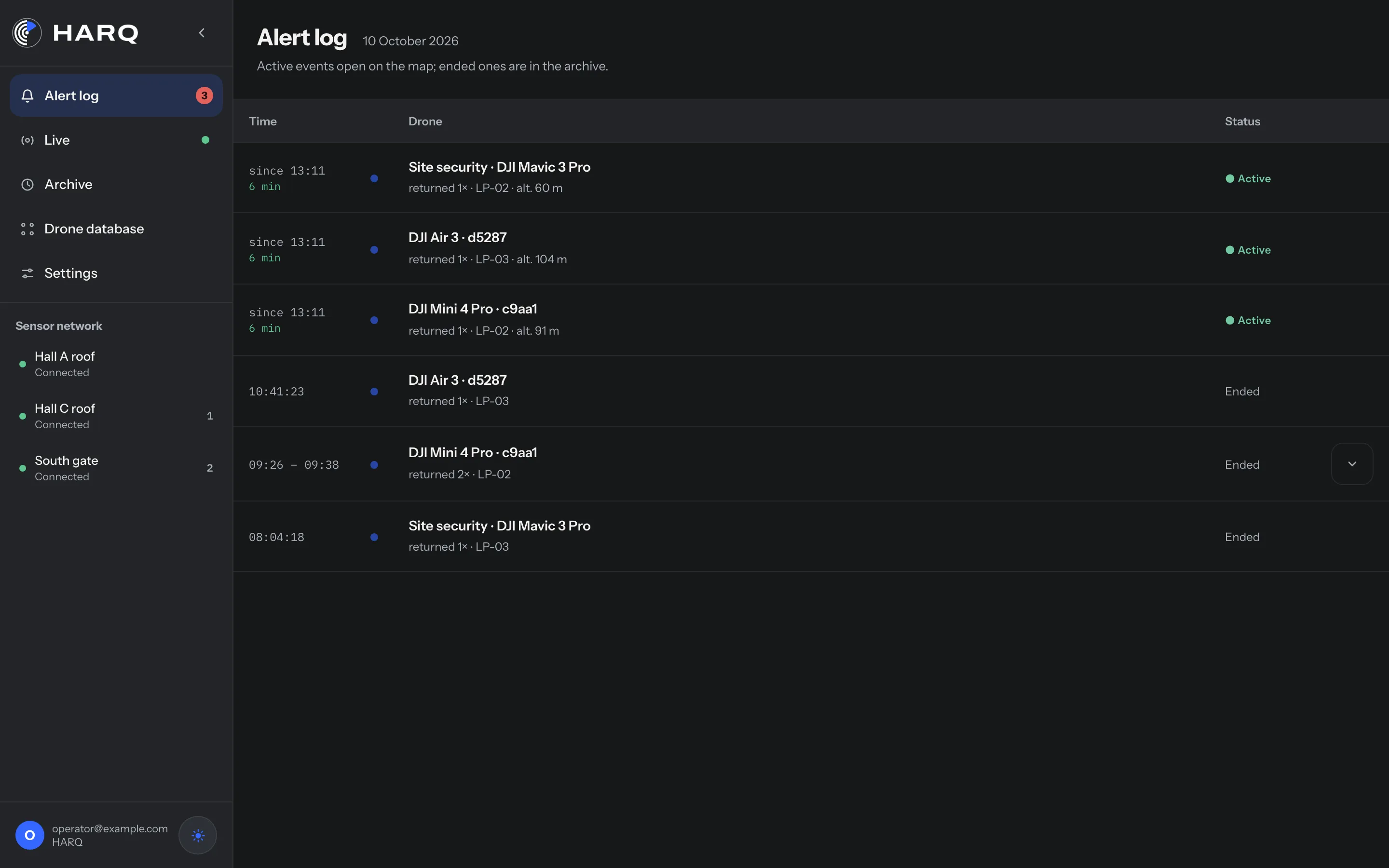
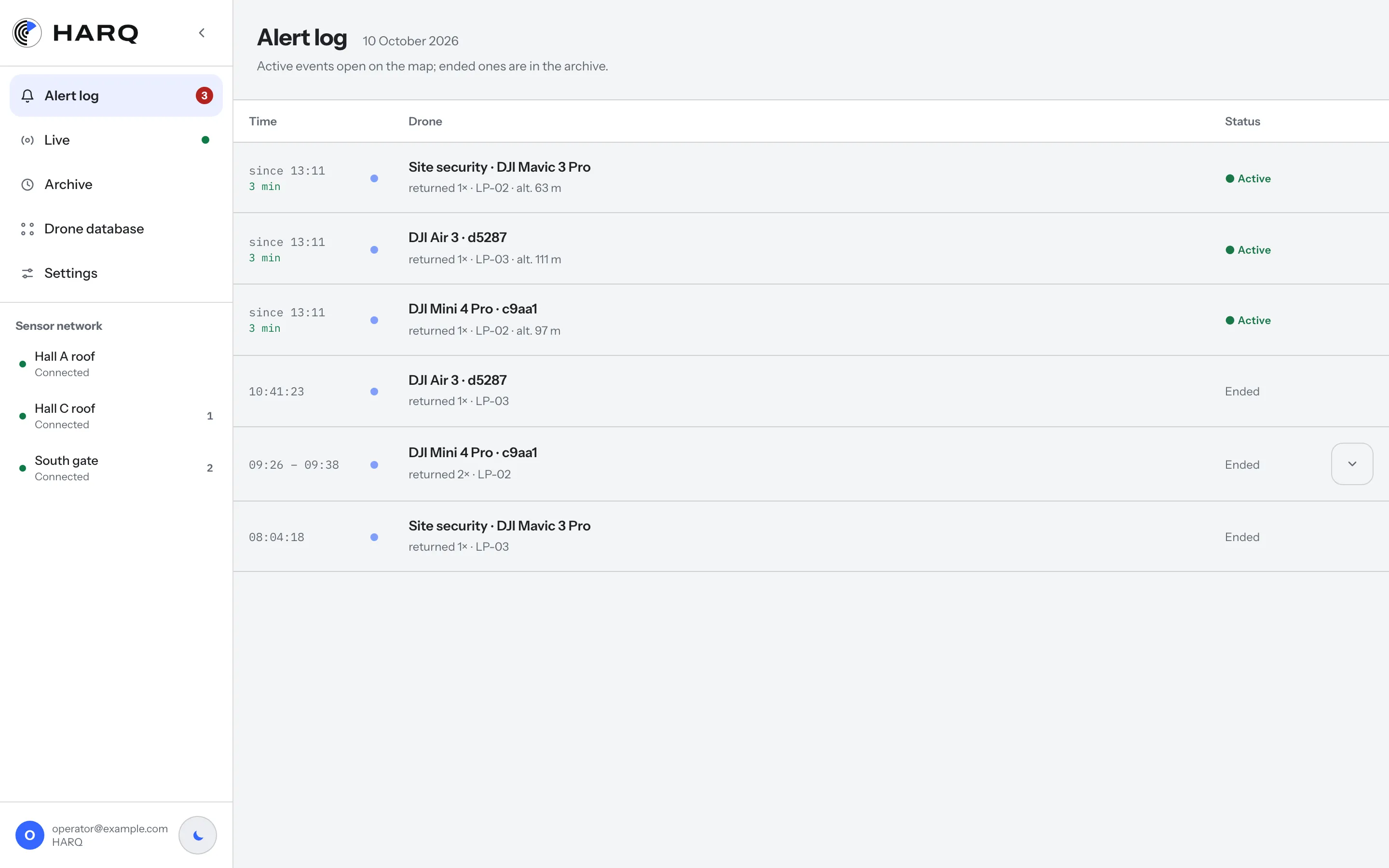
Drone is back: it has been over your site before.


Replay any of the last 30 days, export to CSV or KML and keep what you need for a police report.


How it works
Honest about coverage
Sees
Drones that broadcast Remote ID. Since 1 January 2024, EU rules require it for class C1–C3, C5 and C6 drones and for every drone flying in the specific category.
Doesn't see
Those need radar or RF analysis. HARQ can run alongside such systems as your first layer of protection.
30 days within sensor range
HARQ test site, data from 14 September to 13 October 2026.
Pricing
Prices exclude VAT · annual contract
A warehouse, a single hall or a small site without its own guards. Also the plan for our 90-day trial.
A fenced facility with several buildings and its own security team.
A critical infrastructure operator, or a critical entity designated under the CER Directive.
HARQ doesn't transmit or interfere with anything. The sensor only receives the Remote ID signal that the drone broadcasts on its own. We process data the way we agree with you: together we set recording zones, retention time and access roles.
No. HARQ only receives. It doesn't jam, take control of a drone or transmit any signal.
HARQ can't see them. They need radar or RF analysis, and HARQ can run alongside such systems.
Your team. Each person gets an admin or viewer role. Not even HARQ's own admin panel can open data on flights over your site. We store data on servers in the European Union, and we can name the country in your contract.
Installation takes 2–3 days. An on-premise deployment on your own servers takes longer. The console works as soon as installation is done, and you often see the first drones the same day, depending on how much flies over your site. All we need is a spot high above the ground and a standard power socket. We don't connect to your network.
The sensors belong to HARQ, so we collect them within 30 days. You can end the contract at the end of the term with one month's notice.
Since 4 July 2026, a critical infrastructure operator in Poland may decide that armed security guards (SUFO) can use a jammer against a dangerous drone (Article 6zj of the Crisis Management Act). The jammers must be notified in advance to the interior minister, the President of UKE and the military frequency authority, and every use reported straight away. To make that call, you first need to see the drone and know where the pilot is. HARQ gives you that first layer of protection and a record of every event.
A report showing the number of flights, their times and where the pilots were flying from. You can show it to your board before deciding on an annual contract.
The trial runs for 90 days on the Start plan. We put one sensor where it matters most, and at the end you get a flight report. If you then sign an annual contract, we deduct the trial fee from your first invoice.